When peace becomes the greatest enterprise: the Leadership Talk with Aziz Abu Sarah and Maoz Inon
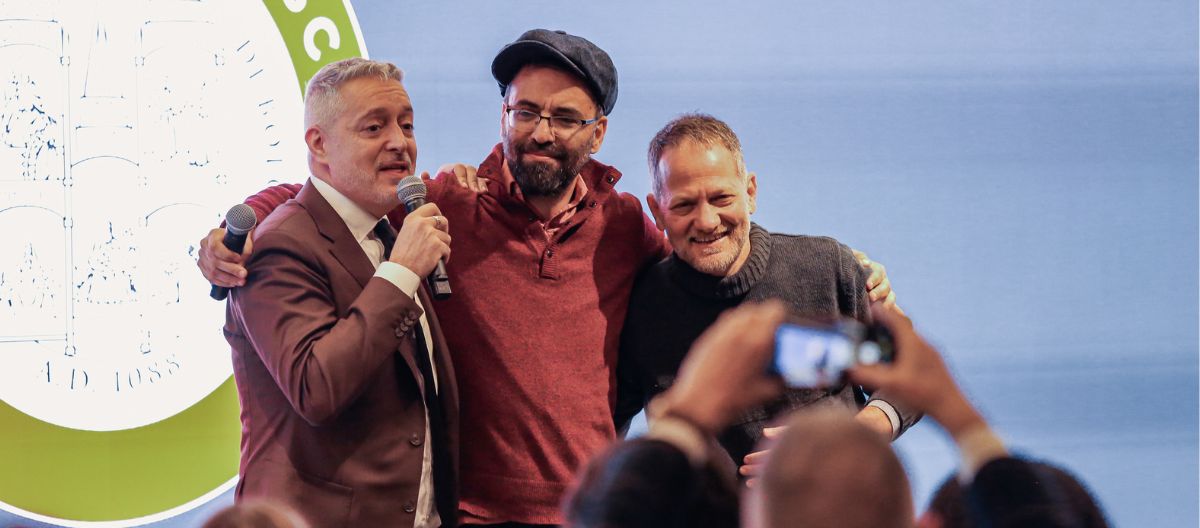
27 January 2026Two men on the stage of BBS New Campus. One Palestinian and one Israeli.
The first lost his older brother, arrested by Israeli army forces and later dying in prison as a result of torture, when Aziz was still a child. The second lost both parents in Hamas attack of October 7, 2023.
In front of students, faculty and guests, they do not accuse each other, they do not debate. They embrace.
Aziz Abu Sarah and Maoz Inon are not only peace activists. They are entrepreneurs who chose to turn enterprise into a tool for dialogue, encounter and reconciliation, building over time initiatives capable of connecting communities in conflict. Their presence at Leadership Talk of Bologna Business School goes beyond reporting on Israeli–Palestinian conflict: it is a lesson in leadership applied to social change.
Tourism as an act of peace
Maoz Inon grew up in an agricultural kibbutz in Negev, about one kilometre from Gaza border. After military service, he travelled extensively, coming into contact with indigenous communities across world: from Māori in New Zealand to Aboriginal peoples in Australia, and Sherpa communities in Nepal.
When he returned home, at around thirty years of age, he realised a simple and unsettling fact: he did not know a single Palestinian.
From this awareness came decision to open a guesthouse in Old City of Nazareth, followed in later years by creation of Abraham hostels in Jerusalem and Tel Aviv. An entrepreneurial journey far from linear, marked by crises, financial losses and new beginnings, which over time led to an organisation able to welcome thousands of travellers each month and engage hundreds of collaborators.
Aziz Abu Sarah grew up in Jerusalem. At nine years old, he saw soldiers take away his older brother, who died shortly afterwards in prison. Years of anger and desire for revenge followed. At eighteen, while attending a Hebrew language course, he met Israelis for first time who were neither soldiers nor settlers. It was a turning point.
From that experience came Mejdi Tours, founded with a Jewish partner: journeys led by two guides, one Palestinian and one Israeli, who tell same places from different perspectives, creating continuous dialogue rather than a single narrative.
What unites their paths is an idea that is both simple and radical: direct human encounter can break down barriers that politics alone cannot overcome. In a world where more than 1.5 billion people travel every year, tourism becomes a privileged space for building understanding and trust.
Five steps from idea to reality
During Leadership Talk, Maoz Inon shared a method that is simple and concrete, developed in world of enterprise and now applied to peacebuilding. Five steps, similar to a business plan, guiding both entrepreneurial action and social change.
Dream. Have a clear vision. Without vision, he recalled quoting the Scriptures, people lose their way.
Define values. Every dream must rest on shared principles. In their case: equality, dignity, mutual recognition, reconciliation, security.
Build a partnership. No enterprise—economic or social—can be built alone. Partnership is what makes it possible to endure moments of crisis.
Create a roadmap. A plan with clear goals and timelines. Peace too, they argue, needs direction and a time horizon: 2030.
Execute. Without action, every vision remains just an idea. Execution is what turns a dream into reality.
Leadership, hope and responsibility
Alongside their entrepreneurial projects, Abu Sarah and Inon have launched new initiatives for dialogue and civic mobilisation, bringing together thousands of people at events dedicated to peace. Their journey also led them to meet Pope Francis at Arena of Verona, where Pontiff referred to them as brothers and helped bring voices of peace movements to attention of G7.
Throughout talk, one message emerges with clarity: leadership does not mean waiting for solutions from above, but taking responsibility for reality, even when it is painful. Hope is not passive—it requires action, responsibility and perseverance.
Leadership for change
Opening event, Dean Max Bergami highlighted how this Leadership Talk represents an opportunity for reflection that goes beyond geopolitical current affairs, touching on themes central for those preparing for roles of responsibility: leadership, ethics, social impact and capacity to generate change.
Because peace is not only a diplomatic issue, but a challenge for humanity, one that requires strategic vision, solid partnerships, rigorous planning and coherent execution. Just like an enterprise.
And, as Maoz Inon recalled through story of his father—who sowed fields of Negev year after year despite floods, droughts and pests—future is not predicted: future is changed.