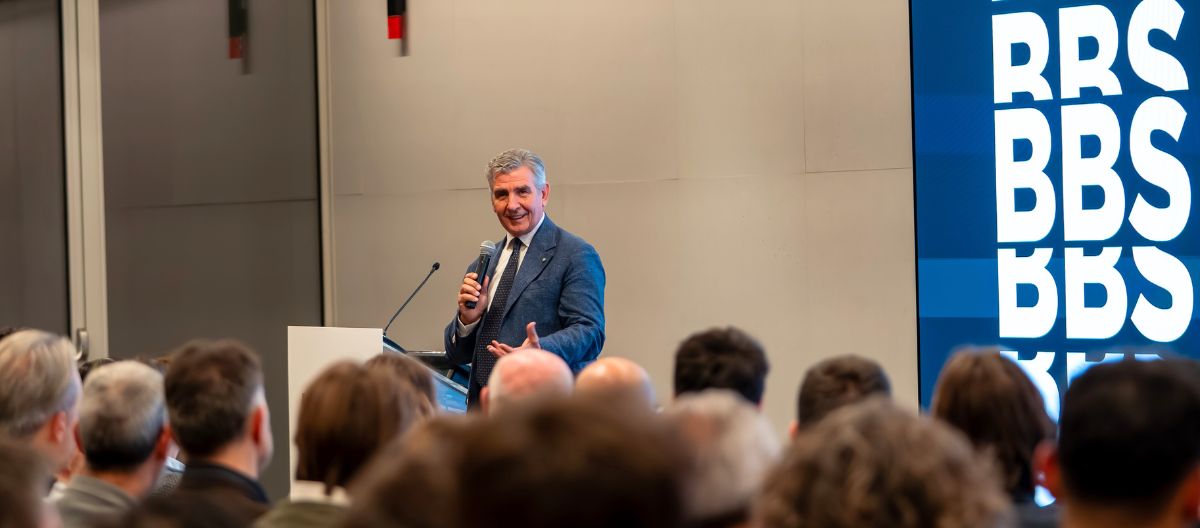
BBS Leadership Talk with Andrea Pontremoli: Innovation, Speed, and the Courage to Fail
16 December 2025Andrea Pontremoli, CEO and partner of Dallara Automobili, was the featured speaker at the penultimate BBS Leadership Talk of 2025, held on Friday 12 December, at the BBS New Campus.
Pontremoli shared with the Bologna Business School Community a broad and highly practical reflection on innovation and speed—two dimensions that, in his experience, are not abstract concepts but everyday practices of leadership, organization, and industrial vision.
The event opened with remarks by Max Bergami, Dean of Bologna Business School, who framed Pontremoli’s long-standing relationship with the School. A faculty member for many years and a key figure in the Executive Master in Technology and Innovation Management, Pontremoli is also very much “at home” in community moments—fondly recalled, with a touch of irony, as the “official DJ” at graduation ceremonies. An introduction that immediately underscored the value of the Community itself: even in the context of such an intense and authoritative talk, feeling at home and actively involved matters, along with maintaining a sense of closeness and lightness.
Pontremoli’s address—more a masterclass than a conventional talk—covered the foundations of innovation management, insisting on a distinction that is often overlooked: innovation is not the same as invention. Invention, he explained, is often the outcome of research and concerns a limited number of people. Innovation, by contrast, is a collective phenomenon: it makes an idea usable by many and, in doing so, turns it into economic and social value. From this perspective, a company is not only an “enterprise”—something that requires a group and cannot be done alone—but also a society: a complex system governed by rules, dynamics, cultures, and relationships. And it is precisely here that innovation truly takes place.
One of the most powerful themes of the talk was error, addressed not as something to be avoided but as a lever for learning and acceleration. The thesis is both simple and uncomfortable: to improve, one must make many mistakes—quickly and at low cost. At Dallara, this is made possible through the intensive use of tools and simulations that allow countless alternatives to be tested before reaching a physical prototype. The point, however, is not only technological; it is cultural. An undeclared mistake remains a mistake; a declared mistake becomes knowledge. And knowledge, when shared, grows. It is no coincidence that Pontremoli mentioned the presence within the company of a role specifically dedicated to managing errors, confirming how organizations can institutionalize what often remains implicit and individual.
Alongside competition and error, Pontremoli focused on what truly makes the difference “when technology changes a hundred times a day”: people. From here, he moved to a very concrete discussion of values, translated into measurable behaviors. At Dallara, the guiding values are humility, loyalty, and curiosity. Humility as the ability to listen and suspend presumption; loyalty as genuine respect in relationships with colleagues, clients, and suppliers; curiosity as a systematic training in asking “why,” going beyond immediate answers. The key point is that values are not assessed through intentions but through behaviors: small, everyday indicators—even seemingly trivial ones, such as punctuality—become signals of the quality of the social system in which people work.
Another central thread of the talk was uniqueness. For Pontremoli, innovation means being able to answer the question, “What do I have that is unique?” Truly essential features are often taken for granted and cease to be differentiating. Innovation, therefore, lies in the ability to build and communicate a distinctive element. From this comes a strategic reflection on market trajectories: on the one hand, increasingly low-cost products; on the other, increasingly premium products and services. In this scenario, Italy—given its productive structure—has less room in the “low cost, large scale” arena and greater opportunity in high value, provided three elements are held together: innovation, marketing, and brand. Marketing, Pontremoli stressed through concrete and memorable examples, is not an embellishment: even the best egg in the world, if it does not “cluck,” risks not existing in the market at all.
The talk then widened its lens from the individual business to the territory, presenting examples and figures related to the Motor Valley and the logic of the value chain. Innovation does not live within the boundaries of a single company, but within an ecosystem that integrates businesses, education, and institutions. It is along this line that Pontremoli invited the audience to shift perspective: from an “ego-system,” centered on oneself, to an “eco-system,” centered on relationships and the ability to generate shared value. A message fully aligned with the spirit of Bologna Business School: educating people who can manage not only skills, but also the human and social complexity those skills must coordinate.
In the final part of the talk, the most provocative insight took the form of a question: if we assume that the technology needed to achieve what we want already exists, then the issue becomes something else—radically human: what do you want to do? No automation can replace imagination, direction, and the responsibility of building a future in which people want to live and work.
The exchange with the audience confirmed the highly engaged atmosphere in the room. In particular, a question about younger generations prompted Pontremoli to overturn a common cliché: it is not true that “young people are worse.” The real risk is depriving them of hope, by failing to offer ambitious goals and genuine trust. Trust, he reminded the audience, is one of the few things that must first be given in order to be received.
In closing, Max Bergami picked up three threads that had emerged with particular strength—error, relationships, and a long-term vision—before the event concluded with thanks and a convivial moment. A fitting ending to an evening that was dense yet practical, capable of bringing together industry and organizational culture, and above all of leaving the feeling of having encountered ideas that could be put into practice as early as the following day, without losing perspective.