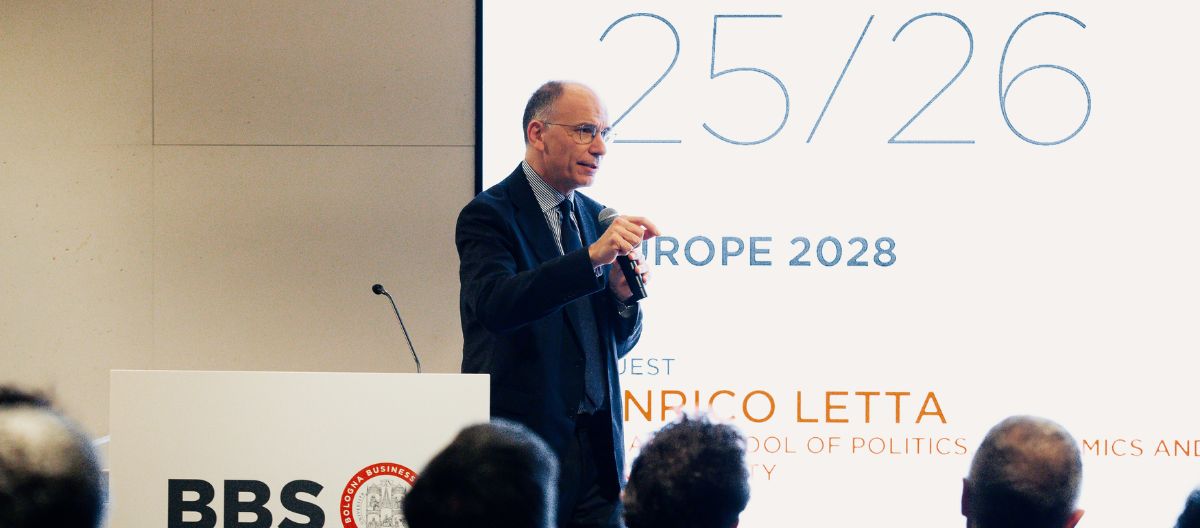
BBS Leadership Talk | Enrico Letta: Europe 2028, a deadline to change pace
4 January 2026The final Leadership Talk of the year brought Enrico Letta to Bologna Business School. Dean of the School of Politics, Economics and Global Affairs at IE University and former Prime Minister of Italy, Letta focused his keynote on “Europe 2028”: not merely a political deadline, but an opportunity to refocus on completing the European project, strengthening competitiveness and reinforcing strategic autonomy.
Max Bergami, Dean of BBS, opened the event by introducing the evening’s theme and outlining the guest’s profile, highlighting the value of a reflection that combines institutional experience with an international academic perspective.
Letta chose a precise starting point: 2028 is not a natural date in public imagination, but it can become one if treated as a true deadline, just as 1992 became the symbolic year of the creation of the European Single Market. Politics without deadlines risks remaining a theoretical exercise; setting a horizon makes it possible to mobilise energy and measure results.
He then turned to what the Single Market has delivered in everyday life: freedom of movement, dismantling of monopolies, competition, easier access to services and mobility. Not an abstract idea, but an infrastructure that has reshaped citizenship and expanded possibilities for individuals and companies. Letta cited several emblematic examples, recalling that Ryanair exists because the Single Market broke the Alitalia–Sabena monopoly, and that the Bosman ruling opened European football by applying freedom of movement to professional players. The Single Market also transformed Italian migrants in 1970s France into European citizens, free to choose where to live.
From here, the core issue of the talk emerged: the cost of European fragmentation today. Letta identified three key sectors that, due to decisions taken in the 1990s, were never fully integrated into the Single Market and now undermine the Union’s competitive capacity: energy, connectivity/telecommunications and financial markets. In a global context where scale matters, remaining fragmented means investing less, innovating with greater difficulty and relying on non-European players.
On connectivity, Letta shared particularly telling figures: a Chinese operator has on average 167 million customers, an American one 107 million, a European one just 5 million. Fragmentation into 27 national operators reduces critical mass and investment capacity, even when it delivers lower prices in the short term. In the 1990s Europe led global telecommunications with GSM and 3G. Thirty years later, leadership and investment lie elsewhere.
In financial markets, the paradox is even clearer: a single currency exists, yet 27 supervisory systems and national rules persist, making it difficult to scale products and services at European level. If you launch a financial product in Italy, the first obstacle is not in the United States or China, but in France. Italians do not pay with French credit cards, nor do the French use German ones. The result is visible in everyone’s wallet: only three card brands, all American. Every electronic payment made in Bologna crosses the Atlantic, as financial circuits are dominated by non-European players. Each year, €300 billion in European savings flows to the United States, attracted by a more integrated and appealing market.
Letta also shared a personal anecdote. After moving to Madrid, he tried to activate an electricity contract. The call centre asked for a phone number and a bank account. An Italian phone number? Impossible. An Italian bank account? Impossible. Protecting national champions, he noted, prevents the emergence of European champions.
This led to the broader issue of “national champions”. Protecting domestic systems may seem reassuring, but it often hinders the creation of European players capable of competing with the United States and China. Letta clarified that this is not about favouring only large groups: the European model thrives on balance between large and small players, territories and supply chains, as exemplified by Emilia-Romagna. Without common rules and integrated markets, even widespread excellence risks remaining undersized.
He then pointed to Airbus as a positive example: there are no 27 national Airbuses, but one European champion capable of competing with Boeing. Where Europe has integrated, it has won. Where it has fragmented, it has lost. In defence, the figures are stark: €140 billion spent to support Ukraine in the first two years of war, yet 78% went to American suppliers, creating jobs in Pennsylvania and Michigan, not in Europe. Fragmentation, therefore, comes at the cost of opportunities and sovereignty.
In the forward-looking part of the talk, Letta outlined two possible levers for change. The first is the idea of a “28th regime”: an optional, uniform regulatory framework valid across Europe in selected areas, offering companies a simplified path to operate at European scale without navigating 27 different legal systems. A fast track for those willing to think European. The second is the need to update the Single Market architecture with a “fifth freedom” linked to knowledge, research, skills and innovation. The original four freedoms—goods, services, capital and people—belong to a 20th-century economy. Today, rules are needed for the intangible economy: automatic recognition of degrees, a European status for researchers, and true mobility of knowledge.
The closing remarks shifted the focus to the political and civic dimension. Letta recalled how integration transformed borders from places of conflict into spaces of cooperation. Today, one crosses the border between Italy and Austria without noticing, yet beneath those tracks lie 100,000 coffins of young people who died to move that border by just 30 kilometres. Millions of lives lost to make Trento Italian rather than Austrian. Strengthening Europe today is not an ideological choice, but an act of realism: without further integration, the risk is structural dependence and loss of autonomy.
The dialogue with the audience addressed key political challenges of the European project: nationalisms that slow integration, common defence, enlargement to countries such as Albania and Georgia, relations with Central Asia, and citizenship for those who live in Europe without being European citizens. In his responses, Letta reaffirmed that Europe’s strength lies in its ability to attract and disseminate values, summed up in two words: freedom and respect. Europe is the only continent where all minorities are represented, where freedom of expression is real, and where mutual respect is a foundational principle. If Europe is strong, these values can radiate outward. If it is weak, its attractiveness fades.
He also answered a question on what distinguishes the European approach from that of Trump—who lays claim to Panama, Greenland or Canada—or Putin, who invades Ukraine. Europe never says “this is ours”. Georgia must decide autonomously whether to join the Union. National sovereignty is a fundamental value. Letta recalled understanding Europe while visiting the Hungarian Parliament, where a representative of the Romanian minority told him: “I love Europe because minorities are represented.” In Europe, we are all minorities, and therefore we are obliged to respect one another.
The meeting concluded with final remarks and year-end greetings. Bergami highlighted the parallel between this talk and the one held the previous week with Andrea Pontremoli: both focused on long-term perspective rather than short-term utility. He closed with a call to action: Europe needs new founders, a coalition of those who believe in integration not for ideology, but for competitiveness. In line with the spirit of BBS Leadership Talks, the message was clear: 2028 can become a turning point only if it is made visible, shared and guided by measurable decisions. A long-term perspective, essential to building European competitiveness and future with operational tools rather than empty rhetoric.