When AI Stops Being Theory: What We Learned from Max Ciociola
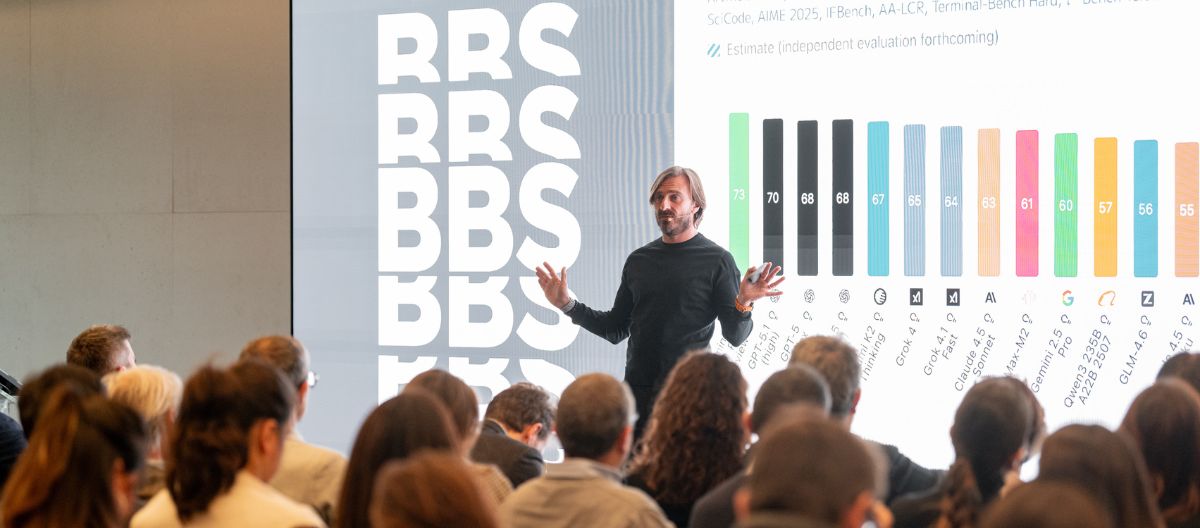
29 November 2025The session with Max Ciociola, founding CEO of Musixmatch, offered Faculty and staff BBS something unusual: a concrete demonstration of how artificial intelligence is already reshaping the way we work, design and teach, rather than yet another theoretical overview.
Ciociola began with a simple observation. The evolution of AI models has accelerated at an extraordinary pace in recent months. We are no longer dealing with chatbots that answer questions, but with reasoning systems capable of tackling complex tasks, from mathematics to code generation, surpassing benchmarks that until recently belonged exclusively to humans.
One of the most significant concepts he introduced concerns the context window, namely the ability of models to process increasingly large volumes of documents in a single session. Ciociola’s example was clear: materials that once required weeks of analysis can now be synthesised in a matter of hours. This is not incremental efficiency but a genuine shift in scale.
The live demonstration reinforced the message. Coding, design and content creation—processes that once depended on dedicated teams and long development cycles—can now be rethought from the ground up. Generative models rewrite code, design functioning platforms, create prototypes from minimal instructions. The impact on required skills is immediate. Operational roles built on data entry, transcription or code checking are evolving into the supervision of models, the management of agents, and the design of automated processes.
The core issue, Ciociola emphasised, is not the availability of technology. It is its adoption. Many European companies still record no measurable impact on their financial performance, not because the tools are immature, but because they struggle to integrate them into existing processes. Cultural resistance, lack of internal skills, fear of change all play a part. What makes the difference is the ability of organisations to invest in training and build professional profiles capable of understanding and governing these tools.
In line with its interdisciplinary approach and daily collaboration with industry champions, Bologna Business School sees artificial intelligence as a driver of managerial transformation, even before a technological one.
The discussion highlighted the need to prepare Master’s participants for a context in which understanding and applying generative models is a transversal competence, relevant across roles and functions.
The School is supporting this transition with rigour and timeliness: by updating curricula, experimenting with new learning tools, and fostering a critical and responsible culture in the use of AI.